Curators by Lance Grande
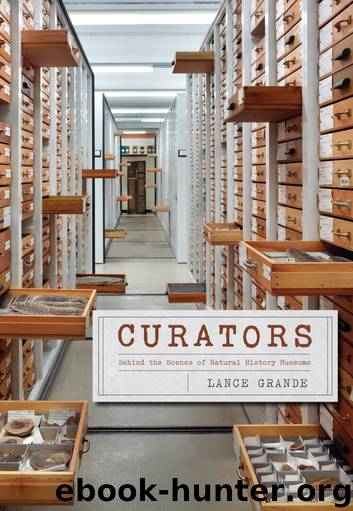
Author:Lance Grande [Grande, Lance]
Language: eng
Format: epub
ISBN: 978-0-226-38943-1
Publisher: University of Chicago Press
Published: 2017-02-10T05:00:00+00:00
In my role as head of C&R, I had a macroscopic view of the great diversity of curatorial skills, accomplishments, and challenges. I increasingly appreciated how the assets of the C&R Division, both physical and intellectual, formed the core of the institution’s mission. We focused on collection-based research and education, while taking on opportunistic institutional collaborations such as the EOL, various university graduate and internship programs, and grant-funded projects. I came to recognize what was required to fuel and manage this operation and how C&R needed to fit in with the rest of the museum’s enterprises. We needed to be flexible enough to take advantage of mission-based opportunities when they arose yet keep an eye toward long-term sustainability. But the road was not easy.
The most challenging issue I had to face while heading C&R was budgeting for the division during the national financial crisis of 2007–8 and the global recession of 2008–12. As these financial crises affected the nation, they also challenged the fiscal stability of museum operations. Revenue was declining from almost every source, including admissions from attendance, store and restaurant sales, investment earnings on the endowment, government support, and philanthropy. A significant bond debt had also grown as the result of major investments in the building, new exhibits, and expanded new programs. The debt added a new major component to the institution’s annual expenses: debt service (interest payments on the debt). Much like the city of Chicago, the state of Illinois, and the federal government itself, the museum found itself over-leveraged. In the words of the museum’s chief financial officer Jim Croft, published in Nebraska Magazine in 2014, “It was the perfect storm—and the harbinger of what became several years of massive operating deficits.” It was a brutal struggle for sustainability, and it took many years to stop the fiscal bleeding.
Even in the best of times, the annual budgeting process for C&R was like solving a puzzle, but cash flow problems added an extra level of difficulty. The budget for C&R each year was roughly $15 to $20 million, which came from a complicated assortment of more than 140 separate funds. Many of these funds and endowments were restricted for specific purposes by the original donor or funding agency. These restrictions would be for things like “purchase of mineral specimens” or “research in the Pacific” or even “conserving archaeological metals in the museum collection.” The trick during the years of financial struggle was to make sure that each fund was used only for what it was restricted for, while using it for budget relief wherever possible to save jobs and sustain operations. The annual budgeting process took weeks of coordinated effort between my office, the scientific department chairs, the museum chief financial officer, and others. As head of Collections and Research, I had to broaden the scale of my external fund-raising efforts, moving from proposals for my own research programs to proposals for the general operation of C&R in order to help keep scientific operations going as smoothly as possible.
Download
This site does not store any files on its server. We only index and link to content provided by other sites. Please contact the content providers to delete copyright contents if any and email us, we'll remove relevant links or contents immediately.
| Africa | Americas |
| Arctic & Antarctica | Asia |
| Australia & Oceania | Europe |
| Middle East | Russia |
| United States | World |
| Ancient Civilizations | Military |
| Historical Study & Educational Resources |
Cat's cradle by Kurt Vonnegut(15365)
Pimp by Iceberg Slim(14522)
4 3 2 1: A Novel by Paul Auster(12405)
Underground: A Human History of the Worlds Beneath Our Feet by Will Hunt(12101)
The Radium Girls by Kate Moore(12036)
Wiseguy by Nicholas Pileggi(5795)
The Fire Next Time by James Baldwin(5454)
Perfect Rhythm by Jae(5411)
American History Stories, Volume III (Yesterday's Classics) by Pratt Mara L(5312)
Paper Towns by Green John(5196)
Pale Blue Dot by Carl Sagan(5013)
A Higher Loyalty: Truth, Lies, and Leadership by James Comey(4967)
The Mayflower and the Pilgrims' New World by Nathaniel Philbrick(4508)
The Doomsday Machine by Daniel Ellsberg(4493)
Killers of the Flower Moon: The Osage Murders and the Birth of the FBI by David Grann(4451)
The Sympathizer by Viet Thanh Nguyen(4398)
Too Much and Not the Mood by Durga Chew-Bose(4353)
The Borden Murders by Sarah Miller(4330)
Sticky Fingers by Joe Hagan(4207)
